

If you are researching ancestors in colonial Mexico (1500s–early 1800s), you will eventually encounter terms like mestizo, mulato, español, indio, or even more obscure labels such as castizo or lobo.
Understanding the casta system is essential for properly interpreting your records — especially if your families lived in frontier regions like Nuevo León, Coahuila, or Nuevo Santander.
This system affected how people were classified, taxed, married, and recorded in church and civil documents. But it was not always as rigid as it appears in paintings.
Let’s break it down in a way that is useful for genealogical research.
What Was the Casta System?
The casta system was a colonial racial classification structure developed in New Spain (colonial Mexico) during the Spanish period. It categorized people based on their ancestry — primarily combinations of:
- Spanish (European)
- Indigenous (Native American)
- African
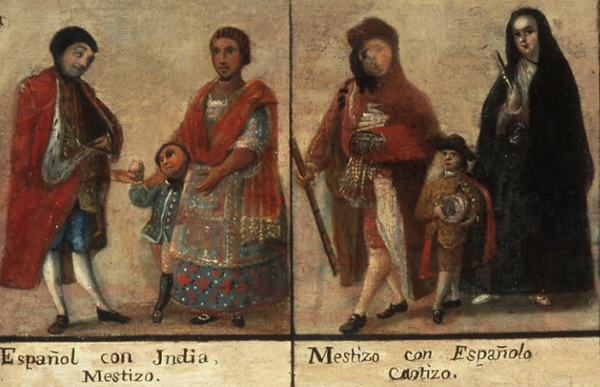
At the top of the social hierarchy were peninsulares (Spanish-born Spaniards), followed by criollos (Spaniards born in the Americas). Below them were mixed categories such as:
- Mestizo – Spanish + Indigenous
- Mulato – Spanish + African
- Castizo – Spanish + Mestizo
- Zambo – Indigenous + African
Dozens of additional labels existed, though many were more theoretical than practical.
How the Casta System Appears in Records
As a genealogist, you will most commonly see racial classifications in:
- Baptismal records
- Marriage investigations (informaciones matrimoniales)
- Census records (padrones)
- Military and land records
- Inquisition or legal proceedings
For example, a baptismal entry might read:
“Hijo legítimo de Juan Pérez, español, y María López, mestiza…”
That one word — español or mestiza — can tell you how that person was socially categorized at that time.
But here is the key:
These labels could change.
The Fluid Nature of Racial Identity
Unlike the rigid charts shown in casta paintings, social classification in northern frontier regions like Nuevo León was often fluid.
A person recorded as mestizo in one record might appear as español in another. Why?
Because classification was influenced by:
- Social status
- Occupation
- Wealth
- Marriage connections
- Reputation in the community
In frontier areas, where Spanish women were scarce and populations were small, families of mixed ancestry could rise socially within one or two generations.
This is especially important for those researching early families of Monterrey, Cadereyta, Cerralvo, Camargo, Mier, or Saltillo.
The Casta System in Northern Mexico
In northeastern Mexico, including Nuevo León and Coahuila, the system functioned differently than in central Mexico.
Why?
- Fewer large Indigenous populations after early conflicts
- Limited African population compared to Veracruz or central Mexico
- Small, interrelated settler communities
- Constant frontier warfare and migration
As a result, racial labels often mattered less than family alliances and land ownership.
Many early settlers simply appear as “español” without further clarification — even when Indigenous ancestry clearly existed.
What This Means for Your Research
Here is how understanding the casta system can help you:
1. Do Not Assume “Español” Means Pure Spanish
Many families labeled español had Indigenous ancestry one or two generations earlier.
2. Track the Label Over Time
Compare how an individual is described in baptism, marriage, and death records.
3. Study Godparents and Witnesses
Compadrazgo networks often crossed racial classifications and reveal social mobility.
4. Research the Local Context
The casta system operated differently in Monterrey than in Mexico City.
5. Look for Marriage Dispensations
If a couple needed dispensation due to kinship, it often reveals deeper ancestry than racial labels do.
The Role of Casta Paintings
The famous 18th-century casta paintings were not census documents. They were artistic and political tools meant to illustrate colonial order.
They reflect ideology more than daily life.
As genealogists, we use them to understand terminology — but we rely on parish and notarial records for truth.
Was the Casta System Permanent?
Officially, yes.
Practically, no.
By the late 1700s, racial labels were increasingly inconsistent, especially in northern regions. After Mexican Independence in 1821, legal racial classifications were abolished.
However, social perceptions lingered.
Final Thoughts for Mexican Genealogists
The casta system is not just a historical curiosity. It directly impacts how you interpret:
- Baptismal entries
- Marriage records
- Census listings
- Social mobility within your lineage
For those researching Nuevo León, Coahuila, Tamaulipas, and South Texas families, understanding the flexibility of racial identity is crucial.
In many cases, your ancestor’s social category tells you more about community status than about genetic ancestry.
And that distinction matters.