
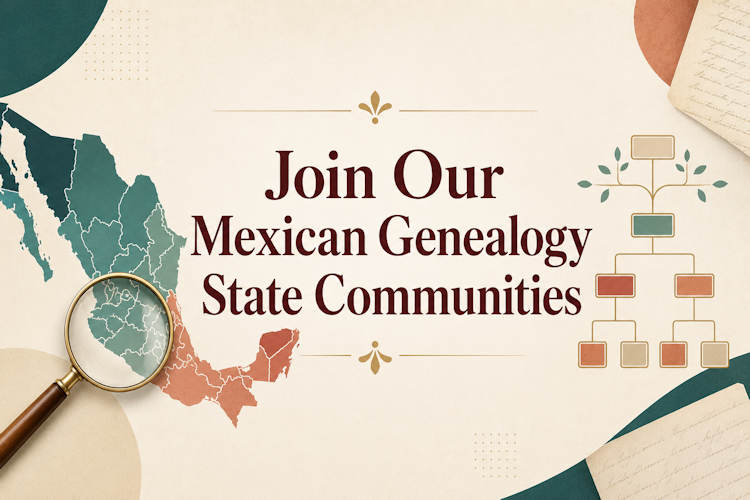

Go Beyond the Main Group: Join Our Mexican Genealogy State Communities
Researching Mexican ancestry often begins with a name, a family story, or a record passed down through generations. Before long, however, every researcher encounters the same important question: Where in Mexico did my ancestors live?
Mexico’s states have distinct histories, archives, record collections, migration patterns, naming traditions, and research challenges. That is why the Mexican Genealogy Community offers Facebook groups dedicated to individual states. These focused communities make it easier to connect with people who understand the places your ancestors called home.
Visit our community page and join the groups for the states where your ancestors lived:
Explore the Mexican Genealogy Community Facebook Groups
Connect With Researchers Who Share Your Geographic Interests
The main Mexican Genealogy Facebook group is a valuable place for learning, asking general questions, and connecting with researchers from across Mexico and the United States. State-specific groups allow you to take the next step by narrowing your research to a particular region.
When you join a group for Nuevo León, Tamaulipas, Zacatecas, Jalisco, Guanajuato, or another ancestral state, you are more likely to meet people researching the same towns, parishes, surnames, and extended families. Someone else may recognize a location in a record, know where a parish collection can be found, or even be researching one of your ancestral lines.
Discover Records and Resources Specific to Each State
Genealogical resources are not identical throughout Mexico. The survival, availability, and organization of records can vary considerably from one state or municipality to another. A state-focused community can help members share information about:
- Civil registration and Catholic Church records
- Municipal and state archives
- FamilySearch collections and digitized images
- Local histories, books, maps, and databases
- Cemeteries, newspapers, censuses, and notarial records
- Record gaps and alternative sources
These recommendations can save research time and lead you to sources that may not appear in a basic online search.
Get Help With Local Places and Changing Boundaries
Mexican records frequently identify ranchos, haciendas, congregaciones, villas, parishes, or municipalities rather than the place names researchers expect to see today. Communities were renamed, jurisdictions changed, and families sometimes used the name of a nearby settlement instead of the official municipality.
Members familiar with a particular state may help identify an old place name, explain which parish served a community, or suggest the archive most likely to hold the records. This local knowledge can be especially helpful when an ancestor seems to disappear from the records.
Learn From the Experience of Other Researchers
Genealogy becomes easier when researchers share what they have learned. In a state group, members can exchange search strategies, record-reading tips, historical context, useful links, and discoveries from local collections.
You can ask questions, contribute resources, help identify names or locations, and learn from the challenges others have already overcome. Even if you are not ready to post, following discussions can introduce you to sources and methods that strengthen your research.
Find Possible Family and Community Connections
Our ancestors did not live in isolation. They belonged to networks of relatives, neighbors, witnesses, godparents, and traveling companions. Researchers studying the same town or region may encounter many of the same families.
A surname match does not automatically prove a relationship, but it can open the door to comparing records, locations, dates, and DNA evidence. State groups create a natural place for those connections to begin.
Join More Than One Group
Many Mexican families moved between neighboring states or migrated north to the United States. Your family tree may include ancestors from several regions, so you do not have to limit yourself to one group. Join every state community that is relevant to your ancestry and follow the conversations that best match your research.
When asking for help, include the ancestor’s full name, an approximate date, and the town, parish, or municipality whenever possible. Specific details make it easier for other members to offer useful suggestions.
Find Your Ancestral State Community Today
The broader Mexican Genealogy community brings us together, while state-specific groups help us dig deeper. By joining the communities connected to your ancestors’ places of origin, you can gain access to more focused discussions, local knowledge, useful resources, and potential family connections.
Visit MexicanGenealogy.com/community today and join the Facebook groups for the states your ancestors called home. Your next discovery may begin with a question, a shared record, or a connection with another researcher.