

When researching Mexican genealogy, most of us quickly become familiar with baptisms, marriages, burials, and civil registration records. These are the records we search first because they often provide the names, dates, and relationships needed to build our family trees.
But there is another type of Catholic Church record that deserves a place in our research toolbox: Mexican confirmation records.
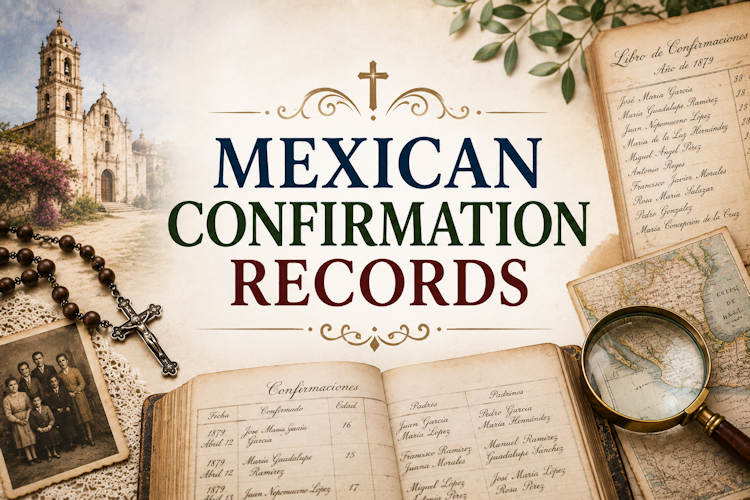
Confirmation registers, usually identified in Spanish as confirmaciones, can provide another snapshot of an ancestor’s life. Depending on the parish, time period, and record format, they may identify parents, godparents or sponsors, ages, birth information, and other details.
More importantly, they can provide evidence from a different moment in an ancestor’s life.
When a baptism cannot be found—or when several people have the same name—a confirmation record may provide exactly the additional clue needed to separate one person from another.
What Are Mexican Confirmation Records?
Confirmation is one of the sacraments of the Catholic Church. Because Catholic parishes recorded the administration of sacraments, confirmation registers survive among the historical church records of many Mexican communities.
Documented fact: FamilySearch’s Mexican Catholic collections demonstrate that confirmation records survive alongside baptisms, marriages, deaths, parish censuses, and other ecclesiastical records. For example, its State of Mexico Catholic Church collection contains records from 1567–1970 and specifically identifies confirmations among the types of surviving parish records.
Similar records survive elsewhere. FamilySearch’s San Luis Potosí collection covers 1586–1977 and includes confirmations, while its Zacatecas collection includes Catholic records from 1605–1980 and likewise identifies confirmation records among the collection’s contents.
This is important because researchers should not assume that Mexican church records consist only of baptisms, marriages, and burials.
What Can a Confirmation Record Tell You?
The amount of information varies considerably from one parish and period to another.
FamilySearch’s description of its Guanajuato Catholic Church collection states that confirmation records may provide:
- Date and place of confirmation
- Name of the person being confirmed
- Birth date
- Parents’ names
- Godparents’ names
Other collections describe similar information. The details found in an individual record, however, should always be verified from the original image whenever possible.
That last point is particularly important.
An online index is a finding aid. The original image is the genealogical record you really want to examine.
Why Confirmation Records Matter to Genealogists
Suppose you are researching a man named José María García who supposedly was born around 1840.
You search the baptismal records and discover three boys named José María García born within several years of one another.
Which one is your ancestor?
A later confirmation record could potentially help.
If it identifies José María’s parents, you have another piece of evidence with which to distinguish him from the other candidates. If it identifies a godparent or sponsor, that individual may provide an additional connection to the correct family.
Interpretation: A confirmation record should not automatically be treated as proof that two people are closely related simply because one served as the other’s godparent or sponsor. However, that relationship is a valuable clue worth investigating.
That distinction between evidence and interpretation is essential.
The record documents an association. Our job as genealogists is to determine what that association meant.
Confirmation Records Can Help When Baptisms Are Missing
One of the most frustrating situations in Mexican genealogy occurs when you know approximately when and where an ancestor was born but cannot locate a baptism. There are many possible explanations.
The baptism might be recorded in a neighboring parish. The relevant volume may be damaged or missing. The record may not have been indexed. The surname may have been written differently than expected. The family might also have been temporarily living somewhere else.
Instead of repeatedly searching the same baptismal index, look for other records created during the ancestor’s childhood or youth. Confirmation should be one of them.
A confirmation record that supplies an age or birth date may help establish an approximate birth period. If parents are named, it can also help connect the individual to the correct household.
It does not replace a missing baptism, but it provides additional evidence.
Use Confirmation Sponsors as FAN-Club Clues
One particularly interesting part of confirmation records is the identification of godparents or sponsors.
Do not simply copy their names into your notes and move on.
Research them.
Ask:
- Who was this person?
- Did the sponsor share a surname with the child’s mother or father?
- Was the person already connected to the family through another sacramental record?
- Did this individual appear as a baptismal godparent, marriage witness, neighbor, or member of the same household?
- Could the sponsor have been an aunt, uncle, cousin, grandparent, sibling, or close family associate?
This is where confirmation records can complement cluster or FAN research.
A sponsor’s name does not by itself prove a blood relationship. It does, however, document a social connection between two people at a particular place and time.
When the same names repeatedly appear around a family, those associations become increasingly valuable research leads.
Search the Entire Confirmation Group
Confirmation registers can sometimes be especially useful because confirmations may have involved groups of people rather than a single isolated family event.
That means you should resist the temptation to find your ancestor and immediately close the record book.
- Look at the surrounding pages.
- Write down other people with the same surnames.
- Look for children with the same parents.
- Pay attention to recurring sponsors.
- Compare ages.
Watch for families from the same ranch, hacienda, barrio, or neighboring community when the record supplies geographic information.
Interpretation: Groups of children appearing near one another in a confirmation register may represent relatives, neighbors, or simply parishioners confirmed at the same event. Their proximity is therefore a clue—not proof of kinship.
This is where careful genealogical analysis matters.
Confirmation Records Can Help Separate Same-Named People
Repeated names are one of the biggest problems in Mexican genealogy.
You may have several men named Juan García, several women named María Rodríguez, and numerous children named José María or María Guadalupe living in the same parish.
Confirmation records create another opportunity to associate a person with:
- Parents
- A particular parish
- A date
- An approximate age
- A godparent or sponsor
When combined with baptism, marriage, death, census, and civil registration records, those details can help construct a much stronger identity profile.
Think of each record as another photograph of the person at a different moment in life.
The more photographs you collect, the easier it becomes to recognize the correct ancestor.
Do Not Assume Confirmation Records Are Indexed
This is probably the most important practical lesson.
Searching for an ancestor’s name and receiving zero results does not mean the record does not exist.
FamilySearch itself notes that its Mexico Baptisms collection is an index of selected records and is not complete for every locality or time period.
The broader lesson applies throughout Mexican genealogy: searchable indexes and surviving record images are not necessarily the same thing.
FamilySearch’s state-level Catholic collections contain millions of digitized images. For example, its State of Mexico collection currently reports more than 4.8 million images.
Sometimes you have to browse.
How to Look for Mexican Confirmation Records
Start with the ancestor’s known parish.
On FamilySearch, locate the Catholic Church collection for the appropriate Mexican state or search the FamilySearch catalog for the town or parish.
Look for headings such as:
- Confirmaciones
- Confirmación
- Bautismos y confirmaciones
- Confirmaciones y matrimonios
Do not stop if there is no obvious confirmation heading.
FamilySearch explains that in larger parishes separate confirmation books were often maintained, while in smaller parishes confirmations could be included with other registers.
That means browsing neighboring volumes and mixed registers may be necessary.
Build a Confirmation Research Table
When you locate a confirmation register, consider extracting more than your direct ancestor.
Create a simple research table containing:
Name | Confirmation Date | Age/Birth Date | Parents | Sponsor/Godparent | Residence | Image Number
Then extract every person sharing your target surname within a reasonable range of pages.
You may begin seeing patterns that are almost invisible when examining records individually.
For example, perhaps three children with the same parents appear in the register. Another child has the same maternal surname and shares a sponsor. That sponsor later appears as a witness at a family marriage.
None of those facts alone necessarily establishes a relationship.
Together, however, they create a research trail.
Compare Confirmation Records Against Other Sources
Never analyze confirmation records in isolation.
Compare the information with:
- Baptismal records
- Marriage records
- Marriage investigations
- Civil birth, marriage, and death records
- Parish padrones
- The 1930 Mexican census
- Burial records
- Notarial records
- Wills and estate documents
Look for agreement and disagreement.
If a confirmation identifies someone’s parents as Juan García and María López, while a marriage record identifies the same parents, the records reinforce one another.
If the records disagree, investigate rather than choosing whichever record fits your existing tree.
The disagreement itself may reveal two different people with similar names.
A Practical Brick-Wall Strategy
The next time you cannot find a Mexican ancestor’s baptism, try this workflow:
- First, establish the ancestor’s approximate birth year and probable residence from marriage, death, census, or civil records.
- Next, identify the Catholic parish serving that community.
- Search or browse the parish’s confirmation registers for a reasonable period after the estimated birth.
- When you find a possible candidate, record every detail—not just the name.
- Then investigate the parents and sponsor separately.
- Finally, compare everything against the ancestor’s marriage, death, children’s baptisms, census appearances, and other known records.
You are not searching for a record that simply has the correct name.
You are building a body of evidence showing that the person in the confirmation register is the same individual who appears in the rest of your family history.
Don’t Overlook the Confirmaciones
Mexican genealogy becomes much easier when we stop relying on a single type of record.
Baptisms are important. Marriages are important. Civil registration is important.
But they are only part of the historical record.
Confirmation registers provide another opportunity to find our ancestors and reconstruct the communities surrounding them.
The next time you browse the Catholic records for your ancestral hometown and see a volume labeled Confirmaciones, don’t skip over it.
- Open it.
- Browse the pages.
- Study the sponsors.
- Compare the families.
The clue that breaks your brick wall may be sitting in a church register you have never searched before.
Sources
- FamilySearch, Mexico, México, Catholic Church Records, 1567–1970.
- FamilySearch, Mexico, San Luis Potosí, Catholic Church Records, 1586–1977.
- FamilySearch, Mexico, Guanajuato, Catholic Church Records, 1519–1984.
- FamilySearch, Mexico, Zacatecas, Catholic Church Records, 1605–1980.
- FamilySearch, Mexico, Baptisms, 1560–1950.