

For anyone researching Mexican ancestry, Catholic Church marriage records are among the most valuable genealogical sources available. These records often contain far more information than civil registrations, including details about family relationships that can unlock entire branches of a family tree. One of the most important concepts found in these records is the distinction between consanguinity and affinity.
Understanding these two terms can help genealogists correctly interpret marriage dispensations, uncover hidden family connections, and better understand the social structure of colonial and 19th-century Mexican communities.
The Catholic Church and Marriage Regulations
In colonial Mexico and well into the 19th century, the Catholic Church regulated marriage. The Church prohibited marriage between individuals who were too closely related. These prohibitions were based on degrees of relationship measured through two categories:
- Consanguinity (blood relationships)
- Affinity (relationships created through marriage)
If a couple fell within a prohibited degree of relationship, they could still marry, but they first needed a dispensation granted by church authorities.
These dispensations were recorded in the marriage documentation and are a goldmine for genealogists.
What is Consanguinity?
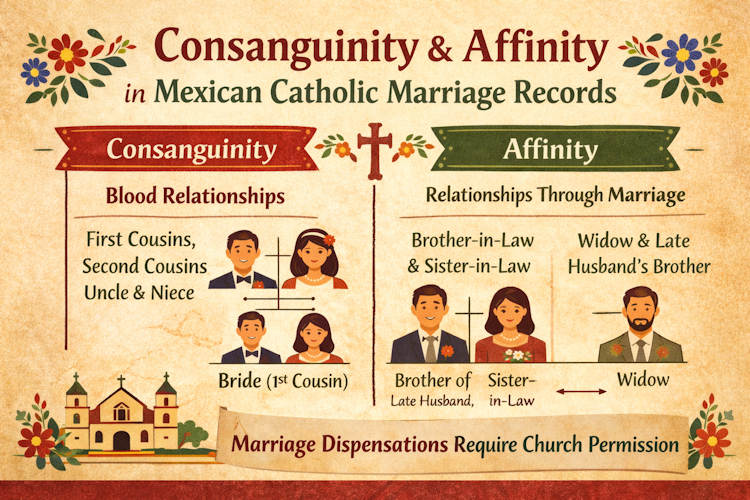
Consanguinity refers to a blood relationship between two people who share a common ancestor.
In small colonial towns throughout Mexico, it was very common for people to marry relatives. Families often lived in the same community for generations, making intermarriage unavoidable.
Common consanguineous relationships found in marriage records include:
- First cousins
- Second cousins
- Uncle and niece
- Third cousins
When a couple was related by blood, the priest typically recorded the relationship in the marriage documentation.
For example, a record might state:
“Dispensa por consanguinidad en tercer grado.”
This means the couple received a dispensation because they were related in the third degree of consanguinity, often indicating they were first cousins.
Sometimes the priest also included the names of the shared ancestors, which can instantly connect multiple family lines.
For genealogists researching families in Mexico, these notations can confirm relationships that might otherwise be difficult to prove.
What is Affinity?
Affinity refers to relationships created through marriage rather than blood.
For example, if a man wished to marry his deceased wife’s sister, that relationship would fall under affinity. Even though they were not blood relatives, the Church considered them related through the marital bond.
Examples of affinity relationships include:
- A widower marrying his late wife’s sister
- A man marrying the widow of his cousin
- A woman marrying the brother of her deceased husband
These marriages also required dispensations because the Church considered these relationships part of the extended family.
A record might read:
“Dispensa por afinidad.”
Sometimes the degree of affinity is also noted, similar to consanguinity.
For genealogists, affinity dispensations can reveal previous marriages, deceased spouses, and extended family connections that may not appear anywhere else in the records.
Where Consanguinity and Affinity Appear in Records
These relationships are most commonly documented in:
- Marriage records (matrimonios)
- Marriage investigations (informaciones matrimoniales)
- Dispensation records
- Parish marriage registers
The información matrimonial is particularly valuable because it often includes testimony explaining how the couple is related and naming multiple generations of ancestors.
In some cases, witnesses were asked to testify about the relationship, producing detailed genealogical statements.
Why These Records Matter for Genealogists
For researchers studying Mexican genealogy, consanguinity and affinity notes provide several advantages:
1. They confirm family relationships.
If a record states that two individuals are cousins, it provides direct genealogical evidence.
2. They identify shared ancestors.
Some dispensations list the exact couple from whom both parties descend.
3. They connect entire family networks.
In small communities, many families intermarried. Dispensations help reconstruct those networks.
4. They explain repeated surnames.
When multiple cousins married each other over generations, surnames appear repeatedly in parish registers.
This is especially common in northern Mexican settlements founded by a relatively small group of original families.
Consanguinity in Northern Mexican Communities
In regions such as Nuevo León, Coahuila, Tamaulipas, and South Texas, intermarriage was extremely common during the colonial period.
Many communities were founded by a limited number of families, including well-known surnames such as:
- Garza
- Treviño
- Guerra
- González
- Cavazos
- Montemayor
- Villarreal
Over time, descendants of these families frequently married within the same extended kinship networks.
As a result, dispensations for consanguinity appear regularly in parish marriage records.
For genealogists researching these regions, learning to recognize and interpret these notes is essential.
Tips for Reading Consanguinity and Affinity Notes
When reviewing Mexican Catholic marriage records, keep these tips in mind:
1. Look for keywords.
Common words include:
- Consanguinidad (blood relationship)
- Afinidad (relationship by marriage)
- Dispensa (dispensation)
2. Pay attention to degrees.
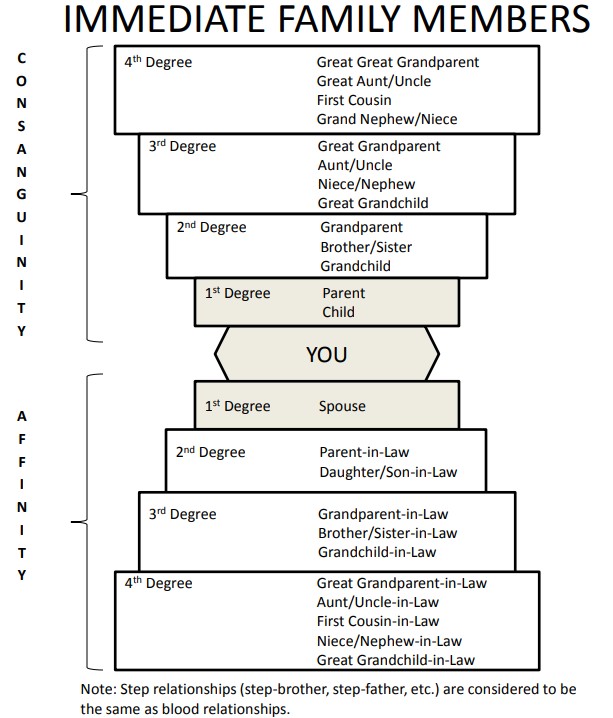
The Church measured relationships in degrees that may not match modern terminology exactly.
3. Search for marriage investigations.
The informaciones matrimoniales often contain much more genealogical detail than the final marriage entry.
4. Build kinship maps.
When several families intermarry, diagramming the relationships can reveal patterns across generations.
Final Thoughts
Consanguinity and affinity dispensations are some of the most informative clues found in Mexican Catholic Church marriage records. These notations not only explain why a couple needed permission to marry, but they also preserve valuable genealogical information about family relationships and shared ancestry.
For genealogists researching Mexican families—especially in regions like Nuevo León and South Texas—learning to interpret these records can unlock generations of hidden connections and deepen our understanding of the communities where our ancestors lived.
The next time you encounter a marriage record mentioning consanguinidad or afinidad, take a closer look. It may hold the key to an entire branch of your family tree.