

Why Every Mexican Genealogist Should Read Origen: Destino. Para la Historia de las Familias Mexicanas
If you have spent years researching your Mexican ancestors, you have likely discovered an important truth: genealogy is about much more than names and dates.
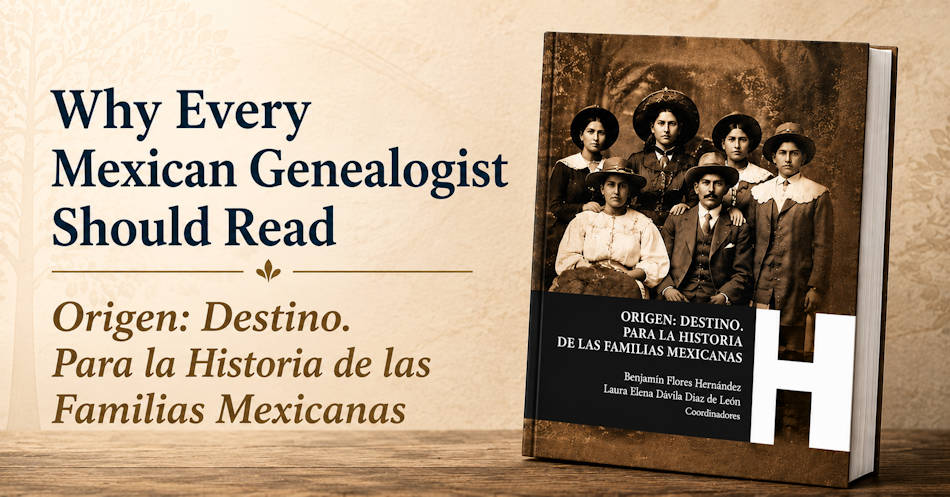
An undervalued resource available to researchers interested in Mexican family history is the book Origen: Destino. Para la Historia de las Familias Mexicanas, published by the Universidad Autónoma de Aguascalientes in 2018. This work was developed from presentations delivered at the First Colloquium on Genealogy and Family History and brings together historians, anthropologists, genealogists, and researchers who explore Mexican families from numerous perspectives.
Unlike many traditional genealogy books, this publication teaches us how to transform family trees into historical narratives.
You can access the free PDF here:
https://editorial.uaa.mx/docs/origen_destino.pdf Note: The book is in Spanish
Genealogy Is More Than a Pedigree Chart
Many researchers begin by asking simple questions:
- Who were my great-grandparents?
- Where did they come from?
- When did they marry?
- Who were their parents?
This book encourages us to ask much deeper questions:
- How did migration shape our families?
- What occupations were passed down through generations?
- How did marriage patterns influence communities?
- How did social class impact our ancestors?
- How did family networks contribute to local economies?
The authors remind us that genealogy is both a historical and documentary discipline that can reveal the social, economic, and cultural realities of our ancestors.
Learn How to Use Genealogy as a Research Method
One of the most useful chapters for family historians is “La genealogía como técnica documental e histórica” by Rosa María García Marín.
The chapter demonstrates that genealogy can be used as a formal research technique, not simply as a hobby. Researchers can use genealogical data to study:
- Migration patterns
- Economic relationships
- Family support networks
- Marriage traditions
- Social mobility
- Community development
This approach is particularly valuable for those researching families in Northern Mexico, Nuevo León, Coahuila, Tamaulipas, Texas, and other regions where migration heavily influenced family histories.
Expand Your Sources Beyond Church Records
Many Mexican genealogists rely almost exclusively on parish records. While baptismal, marriage, and burial records remain foundational, this book highlights additional sources that deserve attention.
One chapter focuses entirely on notarial records (protocolos notariales) and their importance in genealogical research. The table of contents also includes studies that utilize migration records, family reconstruction methods, and anthropological approaches.
These sources can help answer questions that parish records alone cannot.
For example:
- Property ownership
- Inheritance disputes
- Family relationships
- Occupations
- Economic status
- Migration patterns
Discover How Family History Connects to Mexican History
One of the greatest strengths of this book is its breadth.
The publication contains studies covering:
- Indigenous family traditions
- Colonial Mexican families
- Illegitimacy and mestizaje
- Merchant networks
- Noble Spanish families
- Migration studies
- Family histories from Aguascalientes and other regions
- Anthropological studies of family structures in modern Mexico
As genealogists, we often focus narrowly on our direct ancestors. This book reminds us that every family existed within a larger historical context.
Understanding that context helps us interpret the records we find.
Turn Your Research Into Family History
Many researchers collect thousands of names but never tell their ancestors’ stories.
This book encourages us to move beyond data collection and begin writing family histories.
Instead of documenting that an ancestor:
- Was born in 1820
- Married in 1845
- Died in 1888
We can begin asking:
- What was happening in Mexico during their lifetime?
- How did wars, migration, or economic changes affect them?
- What traditions did they preserve?
- What values did they pass down?
Those questions transform genealogy into history.
Why This Book Matters for Mexican Genealogy
Origen: Destino. Para la Historia de las Familias Mexicanas demonstrates that genealogy is an academic discipline capable of connecting individuals, families, communities, and entire regions across centuries.
For anyone researching Mexican ancestors, this free resource offers an opportunity to elevate their research from collecting records to understanding people.
After all, our goal is not simply to identify our ancestors.
It is to understand their lives.
And in doing so, perhaps better understand our own.