

Using the FAN Method to Break Through Genealogical Brick Walls
Every genealogist eventually encounters a frustrating obstacle: the ancestor who seems to appear out of nowhere, the missing maiden name, the undocumented migration, or the elusive record that refuses to surface. These challenges are often referred to as genealogical brick walls, and overcoming them requires more than simply searching for the ancestor’s name again and again.
One of the most effective tools for solving difficult genealogical problems is the FAN Method.
What Is the FAN Method?
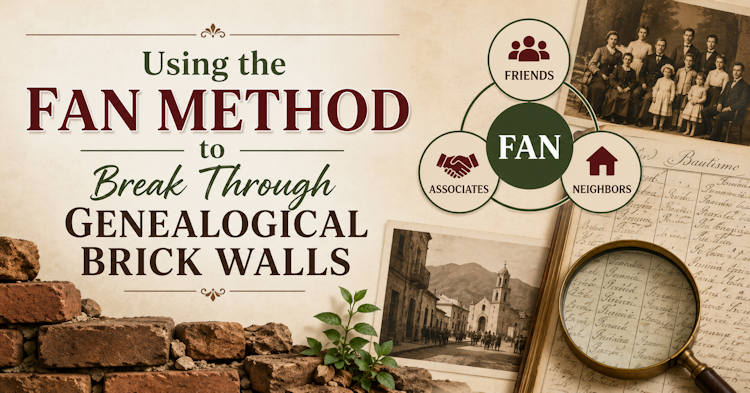
The FAN Method was popularized by professional genealogist Elizabeth Shown Mills and is based on the idea that no person lived in isolation. Instead, every individual existed within a network of relatives, friends, neighbors, business associates, witnesses, godparents, and community members.
FAN stands for:
- F – Friends
- A – Associates
- N – Neighbors
By researching the people who surrounded your ancestor, you can often discover clues that are not found in records directly connected to the ancestor themselves.
Why the FAN Method Works
Historical records frequently contain limited information. A baptism may name only parents and godparents. A land transaction may involve neighboring landowners. A marriage record may include witnesses. A probate record may mention creditors, executors, or guardians.
These seemingly unrelated individuals can provide critical evidence when direct records are missing.
For example, if an ancestor’s birthplace is unknown, studying the origins of their neighbors or marriage witnesses may reveal a shared migration pattern. If a woman’s maiden name is absent from available records, repeated appearances of the same surname among godparents or witnesses may point to her family of origin.
The FAN Method helps genealogists expand their search beyond the individual and into the community that surrounded them.
Identifying Your Ancestor’s FAN Club
Begin by gathering every record associated with the ancestor you are researching. Carefully examine each document and make note of every person mentioned.
Look for:
- Marriage witnesses
- Baptismal sponsors (godparents)
- Confirmation sponsors
- Executors and administrators
- Landowners on neighboring properties
- Census neighbors
- Military comrades
- Business partners
- Migrating families who traveled together
- Individuals appearing repeatedly in records
Create a list and look for recurring names. Repetition often indicates a close relationship.
The Importance of Godparents in Hispanic Genealogy
For researchers working in Mexico, Spain, Latin America, and Hispanic communities in the United States, the FAN Method is particularly powerful because of the importance of compadrazgo—the social and religious relationship established through baptismal sponsorship.
Godparents were often close relatives, siblings, cousins, uncles, aunts, or trusted family friends. In many colonial and nineteenth-century parish records, godparents can provide valuable clues to family connections that are not explicitly stated elsewhere.
When analyzing baptismal records, ask:
- Do the same surnames appear repeatedly as sponsors?
- Are godparents later found as witnesses in marriages?
- Do sponsors come from the same town or region?
- Are there patterns connecting several families?
These connections frequently lead to discoveries about kinship networks and migration routes.
Using Neighbors to Solve Migration Mysteries
Neighbors can be just as important as relatives.
Families often migrated together, settled near one another, and intermarried over multiple generations. If your ancestor suddenly appears in a new location, study nearby households.
Ask yourself:
- Who lived nearby?
- Did they originate from the same community?
- Do they share surnames found in the ancestor’s earlier records?
- Did they purchase land from one another?
Entire communities sometimes relocated together, leaving a trail that can help identify an ancestor’s place of origin.
Case Study: Finding an Unknown Origin
Imagine an ancestor appears in Mier, Tamaulipas in the early 1800s, but no record reveals where he was born.
Traditional research may fail to locate his baptism.
Applying the FAN Method, you examine:
- His marriage witnesses
- His children’s godparents
- Neighboring families in census and land records
Several of these individuals are traced to Monterrey. Further investigation reveals that multiple families migrated from Monterrey to Mier during the same period.
A search of Monterrey parish records ultimately uncovers the ancestor’s baptism.
The breakthrough did not come from researching the ancestor directly—it came from researching his associates.
Building a FAN Research Plan
When confronted with a brick wall, try the following approach:
- Identify every person associated with your ancestor.
- Create a spreadsheet or research log.
- Record where and when each individual appears.
- Research their origins and family connections.
- Map relationships between families.
- Look for recurring surnames, locations, and migration patterns.
- Follow the evidence wherever it leads.
Often, the answer lies not in the missing record itself but in the records of those who stood beside your ancestor.
Final Thoughts
Successful genealogy is rarely about finding a single record. It is about understanding the community in which an ancestor lived. The FAN Method encourages researchers to widen their perspective and recognize that family history is built upon networks of relationships.
When direct evidence is scarce, friends, associates, and neighbors can provide the missing pieces of the puzzle. By studying the people around your ancestor, you may discover clues that lead to new generations, unknown origins, and solutions to long-standing genealogical mysteries.
The next time you encounter a brick wall, remember: sometimes the key to finding your ancestor is not searching for them at all—it is searching for the people who surrounded them.